

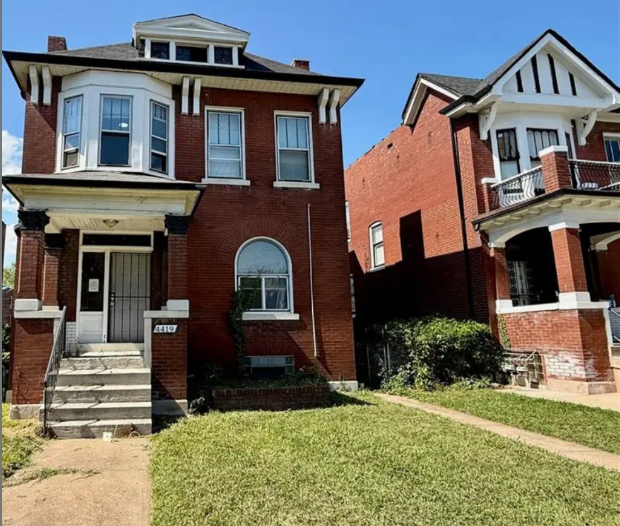
A bold, transformative initiative is emerging in North St. Louis. Known as the Reparations Investment Company (RIC), its goal is to create “renovation that contends with gentrification!” RIC is the latest expansion of the Black Power Blueprint, led by African People’s Education and Defense Fund (APEDF) Board President Ona Zené Yeshitela, to contribute towards building independent political and economic power in the hands of the African community.
Coordinated by the Uhuru Solidarity Movement as a concrete expression of material solidarity with African self-determination, the Reparations Investment Company is a joint program of the APEDF and Black Star Industries. RIC raises resources as reparations for Black community-led revitalization through property renovation and community ownership in North St. Louis.
The RIC is part of the African community’s work to build their own solutions, reclaim control of their property and neighborhoods, and revitalize the northside on their own terms.
RIC is organizing investors, including from the white community, to invest funds in the acquisition and renovation of properties to materially contribute towards the African community-driven revitalization.
As Chairman Omali Yeshitela has said, to support RIC is to make “the greater investment” in a future where African people have self-government and power over their own resources, land, lives and destinies.
This is how we take a genuine stand to overturn the Delmar Divide, a symbol of the legacy of colonialism in this city that prioritized development and prosperity for the southside at the expense of the northside.
Through decades of deliberate colonial city government policies, including the notorious Team 4 plan of the 1970s, the city has intentionally let the once-thriving northside African community deteriorate as part of a plan to displace the neighborhoods and gentrify the northside.
This process has been underway for decades and reached new levels with the building of the National Geospatial-Intelligence Agency, a CIA spy agency constructed less than two miles from the Uhuru House.
The government is now exploiting the devastation caused by the May 16 tornado as an opportunity to accelerate this destructive plan at the expense of the African community.
This is why the Black Power Blueprint became necessary–taking the struggle beyond protest toward the capture of power. For nearly a decade, the Black Power Blueprint has been transforming the northside, acquiring properties and developing them into beautiful and uplifting self-reliance programs, such as the Uhuru House, Shamba La Uhuru Freedom Farm, One Africa One Nation Farmers Market, Community Basketball Court, and more.
RIC is the Black Power Blueprint’s response to the fact that North St. Louis has literally thousands of abandoned properties left to rot by the city. RIC is a campaign to bring those properties under the ownership of African people themselves so that they can be repaired into beautiful homes for sale and rental in the community.
This is solidarity with African people’s right to stay in their neighborhoods and bring power back to North St. Louis. This is revitalization through self-determination, as opposed to displacement and extraction.
The resources of the RIC will circulate within the northside and contribute towards African economic self-reliance. Rather than the city government or outside developers coming in and deciding what happens to the real estate on the northside, RIC means that the African community itself will decide.
The proceeds raised from the sale of properties will go back towards funding the economic development programs of the Black Power Blueprint. In other words, the impact of each property renovation will be exponential.

RIC is building a reparations-centered network of investors, donors, contractors, skilled laborers, and volunteers who contribute towards sustainable, black community-driven real estate acquisition, renovation, and development that generates lasting social impact for the whole community.
Since its launch, the Reparations Investment Company has acquired two properties—one on Harris Ave and another on Holly Ave—and is working fast to repair the roofs and begin construction and renovation on both homes.
We invite you to become an investor and take a concrete stand for reparations! We call on all contractors, real estate attorneys, painters, systems contractors, roofers and carpenters, handypersons, and volunteers to join this effort and contribute their skills and labor to this African community-led project!
We call on white people to join this momentous new development in the work to build white solidarity with African self-determination! This is reparations in action!
As Chairman Omali Yeshitela says, this is the “new world, under construction.”
Contact info@uhurusolidarity.org to become an investor and/or volunteer with RIC.Unity through Reparations!
Uhuru!


