

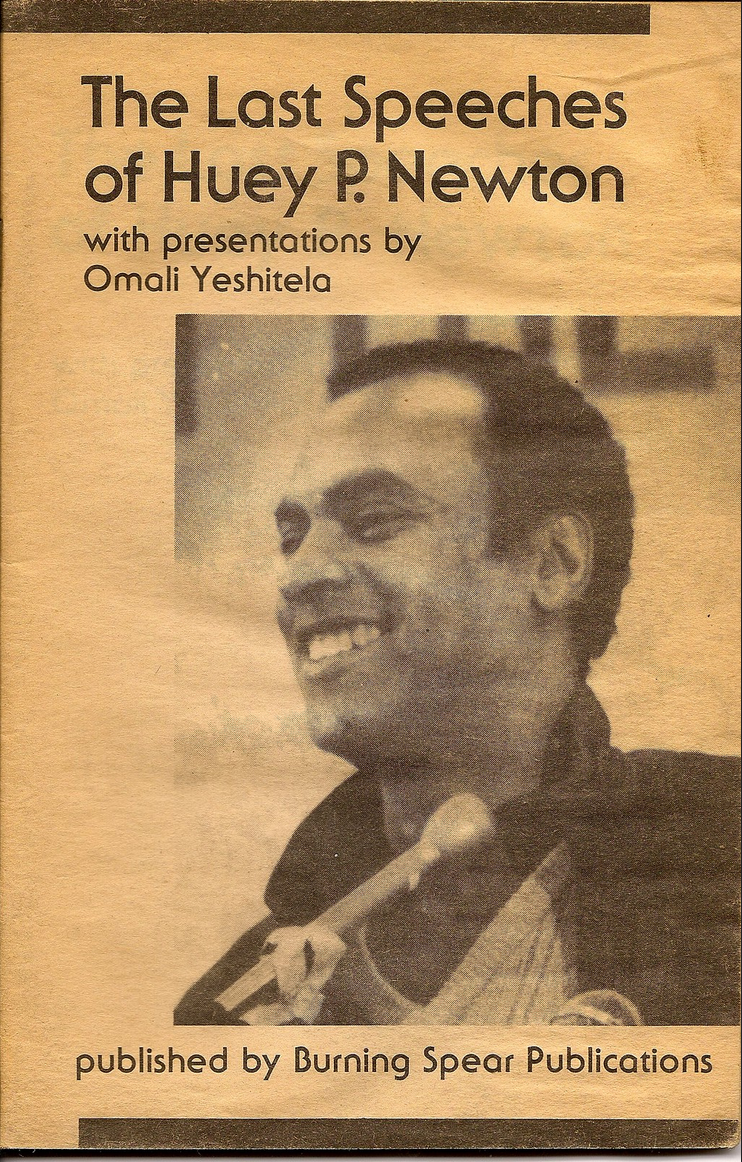
This is a speech given by Huey P. Newton, co-founder of the Black Panther Party, on December 28, 1986 at the Oakland Uhuru House.
Freddie Roberts must be released. We must continue to work for that.
I am uncomfortable speaking; I’ve never been too good at lecturing. They used to say I was pretty good with the gun. (applause)
It is very important to keep our history going. Too often black history is not recorded; it’s forgotten about. This keeps us from knowing what direction to go in the future.
You might not have the Black Panther Party but you have the Uhuru House; you might not have The Black Panther newspaper but you have The Burning Spear. So they really haven’t done anything by crushing one organization. (applause)
One time when I talked to some Vietnamese during the Vietnamese war when the U.S. was attempting to enslave those free people, I kept saying I was a freedom fighter, that I was fighting for freedom. The Vietnamese said, don’t say that. I said, what’s wrong with saying that. They said, we fight because we are free; we fight against slaves.
I can imagine that sometime a group of slaves will get shackles and put them on a free person and our job is to be released from those shackles, and perhaps we can make the slaves free also.
That puts us in a position to know who we are and who we are fighting against. We’re fighting against unconscious people, blind people and slaves. We have to fight from a strong attitude and know that we’re free, and we’ll break the shackles in order to free everyone else. That’s the nature of the struggle. It’s not truly a race struggle. Some slaves turn it into that but we must see the light.
l’ve been tried at least two times a year for about 20 years now. There have been about 58 charges against me all together.
They’ve charged me for everything but being a child of god.
Due to the people’s will I’m still out here. Sometimes I’m amazed at the power of the people, because I didn’t believe that I would live to be over 25, and then after that I didn’t think I would ever get out of prison, but I’m still here, I think this is mainly because of the movement exposing the government through the Freedom of Information Act. At one time the movement was in a high ebb, and then we restructured, but I see a growing spirit here in Oakland. It’s beautiful to see the young people singing those lines, because we are building a revolutionary fervor in our youth.
I’ll be very brief because I’m scared to death of speaking to more than two or three people at a time. This used to be Bobby Seale’s job. (laughter)
In 1970 we created the Oakland Community School. By 1982 we were no longer able to run the school so we closed it down.
The accounting books had to be examined, but someone burned them, so I was charged with the burning of the books and charged with not even running a school.
They charged me with embezzling $500,000 to a million dollars. In other words the school never existed, the children were never fed and the teachers never paid because someone burned the books. So they are saying that since we couldn’t show it on paper, then we didn’t run a school at all. Of course the people in Oakland and the recipients of that program know very well that the school was run.
I was in preliminary hearing but we took a break because of my attorney’s involvement in a murder trial. The State usually has pretty bizarre star witnesses against me. I remember they had eye witnesses against me who were night blind testifying about a situation they say happened at night. In ’67, they had a bus driver testify that he stood three feet away while I executed a policeman. Then when his supervisor testified we found out the bus wasn’t there at all, it was about five miles away.
Of course these convictions and persecutions would have been upheld if the people hadn’t kept exposing them, not only to our community in the U.S., but to the community of the world. The movement should be viewed as a global movement in order to have as much strength as possible.
Freddie’s case is so similar to what happened to me in ’67. My case was like a dress rehearsal so we do have some history on how to handle the tactical part of a case, the other is just hard work.
I’m very impressed with the energy being put out now, and I plan to be more in touch with the Uhuru House. (applause)
As a matter of fact, after the school closed, someone burned the building. We lost much of the films and books and so forth.
That’s a criticism of myself–if I had been more in touch maybe I could have gotten a lot of our history out of the school into the Uhuru House before the building was burned. Of course we know who burned the building. They haven’t charged me with the burning [of] the building yet. I’m looking for that next.
I’d like to say “Power to the People,” and thank you very much, (applause).


