

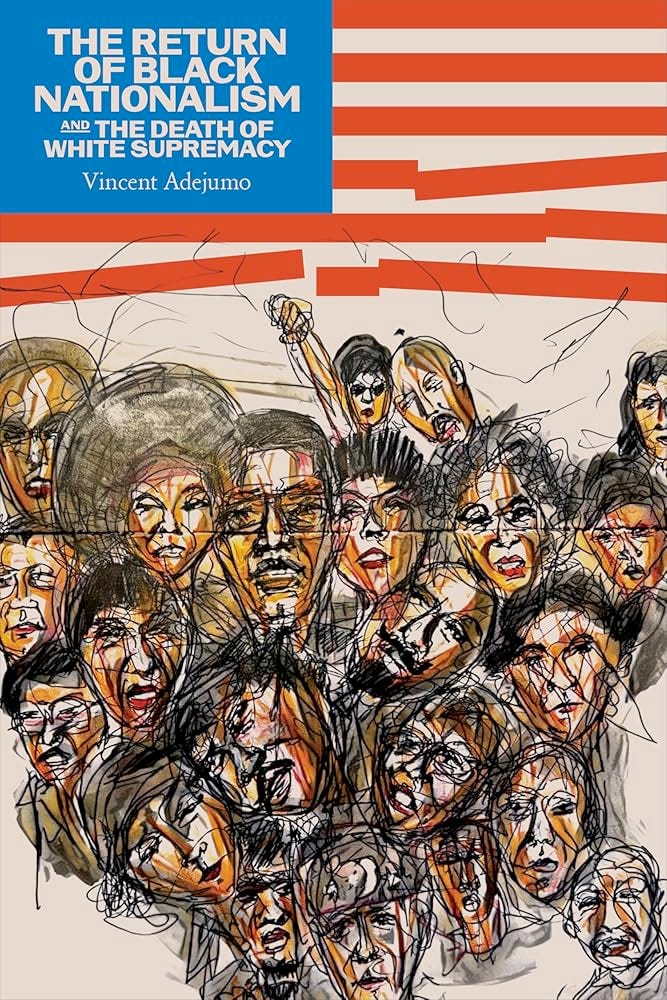
In May 2025, political scientist Vincent Adejumo released his debut book, “The Return of Black Nationalism and the Death of White Supremacy.” Adejumo’s book is an important intervention into the canon of academic literature on African Liberation inside and outside the United States.
For Adejumo, “Black nationalism in itself is not singular. It encompasses a multitude of concepts which include black empowerment, black radicalism, nation within a nation, separatism, Pan-Africanisms and African Internationalism.” In short, black nationalism, for Adejumo, is the political project for African Independence.
Adejumo tells a story of African independence in the United States that begins with the maroon societies, specifically the Black Seminoles of Florida, and concludes with the rise of the African People’s Socialist Party (APSP), African Internationalism and the leadership of Chairman Omali Yeshitela.
Adejumo recognizes the unity of politics and economics
Adejumo earned his Ph.D. Political Science from the University of Florida in 2015. “The Return of Black Nationalism” is Adejumo’s first book. His doctoral thesis analyzed the problem of for-profit higher education. Despite its difference in content, his research interests carry over to “The Return of Black Nationalism.”
Adejumo clearly argues against the influence of outside political and economic interests in African liberation. While Adejumo’s title identifies the death of white supremacy, it is also about the complete failure and death of integrationist politics.
Adejumo is from Tampa and actually completed his undergraduate studies at Florida State University alongside International People’s Democratic Uhuru Movement (InPDUM) member, Takara Waller, the great-niece of Chairman Omali Yeshitela and granddaughter of APSP National Director of Organization Chimurenga Selembao at Florida State University. Though he was raised across the bay from St. Petersburg, he noted that he learned of the Uhuru Movement during his studies.
Throughout the book, Adejumo pays keen attention to independent African economic development. Adejumo is the founder and operator of the independent Olu Institute of Learning.
Chronicles African liberation history
In a personal conversation, he explained that it was the unified political and economic vision of the Uhuru Movement that attracted him to African Internationalism and the work of the Party and Chairman Omali Yeshitela.
“The Return of Black Nationalism”is comprehensive and comprehensible. Alongside the broad reach of the Oxford Debate, his book gives concrete evidence that African Internationalism is becoming the predominant worldview. “The Return of Black Nationalism”clearly displays our movement for African Liberation as a centuries-old project and that the APSP sits at the head of that project.
In the six chapters that make up the body of the book, Adejumo surveys the history of black nationalist thought, the history of African liberated territory, African resistance to colonial education, as well as different models for repair, including the struggle for reparations, political power, and economic justice.
A comprehensive view of Uhuru Movement history
The final chapter in the body of the book, “Liberation,” chronicles the Uhuru Movement. With the exception of maybe some of the work of the late Rod Bush, Adejumo is the first author, outside of the Uhuru Movement, to display such a complete and total history of the Uhuru Movement, Chairman Omali Yeshitela and African Internationalism.
Adejumo begins with the Battle of St. Pete and the defense of Tyron Lewis in 1996. He clearly shows the murder of Tyron Lewis as connected to the historic attack against African political and economic independence in St. Petersburg. He then reaches back to tell the story of Chairman Omali’s voyage into political life, the advent of African Internationalism, the creation of the International People’s Democratic Uhuru Movement and the Revolutionary National Democratic Program.
Adejumo salutes the leadership and work of Deputy Chair Ona Zené Yeshitela. The chapter culminates with an expose of the Uhuru Movement’s economic institutions, including the African People’s Development and Empowerment Fund, Black Star Industries and the Black Power Blueprint.
The clarity of African Internationalism is displayed
Adejumo outlines the difference between African Internationalism and Pan-Africanism as well as Black Internationalism. For Adejumo, African Internationalism offers the most complete vision for African Independence. African Internationalism has evidence of practical work grounded in the liberation and empowerment of the black working class.
With the development of African Internationalism, over 50 years ago, Chairman Omali Yeshitela gave shape and development for the 600-plus years of African anticolonial struggle. In June 1977, The Spear published “A Short History of African Internationalism.” Much like that article, “The Return of Black Nationalism”shows how our history of struggle clearly displays the trajectory towards the Party.
Adejumo has some omissions in his book, likely because he did not have access to these materials. For example, Adejumo calls for the creation of a singular black nationalist political party. The 1977 “Tactics and Strategies” pamphlet, as well as a section on the Black is Back Coalition, would have deepened Adejumo’s concluding argument.
Also, Adejumo presents the clarity of the Party line. It’s important that African Internationalism isn’t just painted as a synthesis of Pan-Africanism and Marxism, as other African scholars, even those favorable to the Uhuru Movement, have done.
The key historical difference between African Internationalism and what is termed Black Internationalism, however, is not found in the 2002 essay by legal scholar Jeffrey Brown that Adejumo cites. The real departure between African Internationalism and Black Internationalism would have been from the 1966 “World Black Revolution” paper by Max Stanford and the Revolutionary Action Movement. This is where Max Stanford argued Black Nationalism was actually Black Internationalism because it was a world movement. Still, Adejumo makes a much-needed comparison.
Should be studied alongside our works, for the fullest effect
Adejumo is a political scientist and not a historian, as I am. This means that we have differing levels of archival experience. For this reason, these content limitations do not diminish the significance of “The Return of Black Nationalism.” Adejumo’s book is a useful piece of political education.
It joins the publication of The Burning Spear digital archives at the University of Florida, as well as other significant publications, in displaying the reach of Chairman Omali and African Internationalism. It is important that such a clear reflection of African Internationalism was displayed back at us.
For its fullest effect, and to pull it out of the abstraction of the academic world, this book should be studied in addition to works that Burning Spear Publications has produced. These works include: “The History of the Party” in “An Uneasy Equilibrium”; “Why I Became a Revolutionary”; “Not One Step Backwards”; “The Verdict is In: Reparations Now!” and the documentary, “Relentless: 50 Years of Leadership Toward African Redemption.”


