


“Don’t agonize, organize!” rang through the flora and fauna of Malcolm X Park and the concrete jungle that is Washington, D.C., as organizers from across the U.S. and members of the Black is Back Coalition (BIBC) for Social Justice, Peace and Reparations marched together for the 17th Annual Black People’s March on the White House.
Held every year since the inaugural march in November 2009, the BIBC has kept its promise of uniting African and oppressed peoples against the U.S. imperialist war waged on oppressed people since its inception.
This Substack is reader-supported. To receive new posts and support my work, consider becoming a free or paid subscriber.
Federal repression and resistance
This year’s march is made more significant by the fact that federal troops now stalk the streets of D.C. and many other U.S. cities to intimidate and strike fear in the hearts of those who dare to resist. It also comes shortly after the September 25 White House memo that publicly declared war on colonized people who resist—using the red herring of “political violence” as the vaguely defined enemy.
This memo declares war against what it characterizes as “a culmination of sophisticated, organized campaigns of targeted intimidation, radicalization, threats and violence designed to silence opposing speech, limit political activity…”
This memo, however, is simply the overt expression of how the U.S. has always operated against progressive forces throughout its history. Instead of lurking in the shadows as it did in the 1960s through the counterintelligence program, the State now openly declares its policies against those it deems antithetical to its colonial capitalist domination.
But despite these and many other forms of repression of progressive voices, the BIBC was not cowed into submission. If anything, doubling down on our resistance and organization became the order of the day.
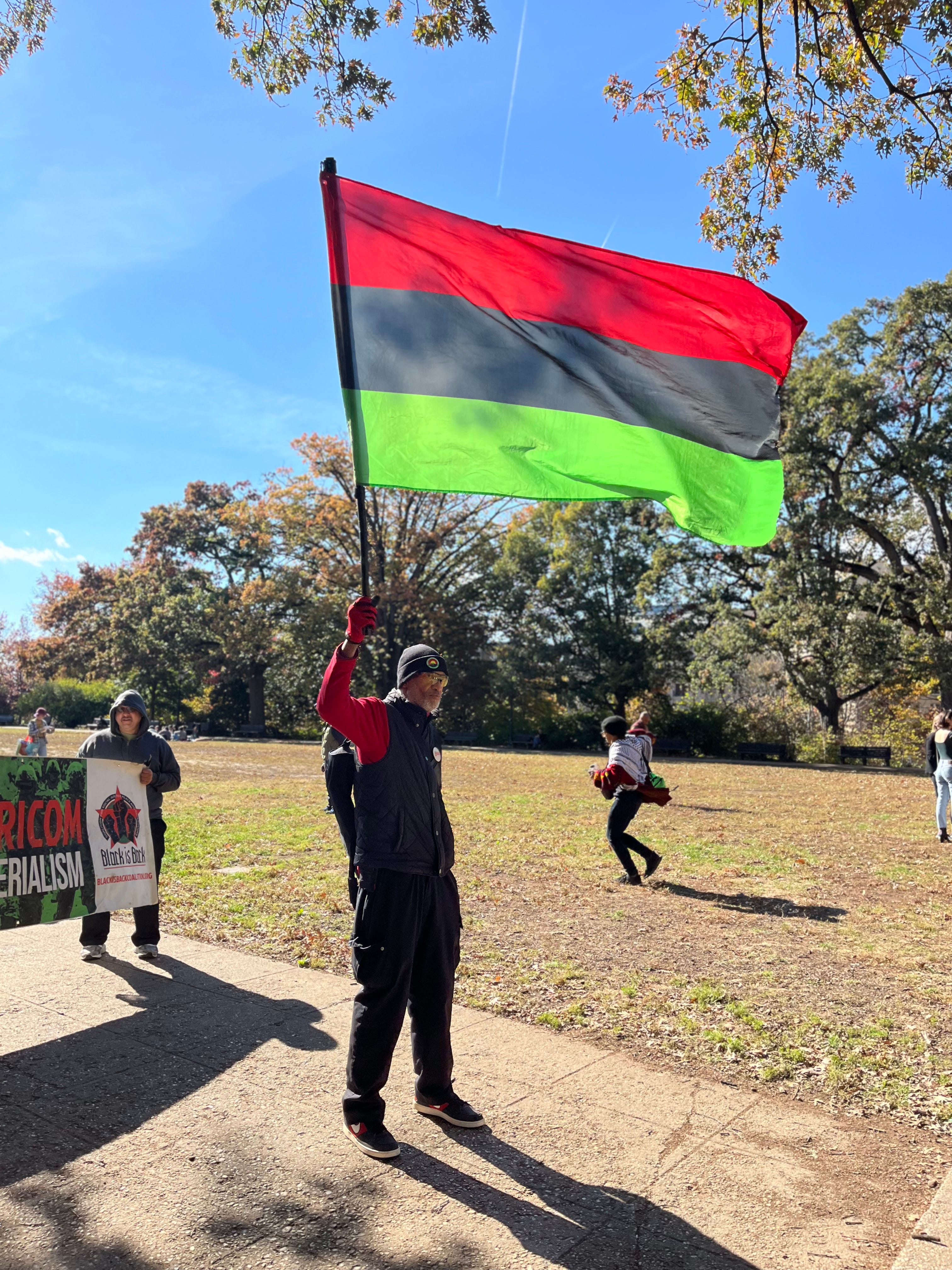
The rally before the march
The pre-march rally included a dynamic program of speakers and a cultural performance by the Black Workers Center Choir.
The fearless Comrade Lisa Davis, Vice Chair of the BIBC, assisted by the steadfast Comrade Ekenge Mayele, served as MC for the rally and introduced speakers from across the coalition. She opened the program with the revolutionary slogan, “Uhuru means freedom! I want y’all to say it like you mean it!”
Comrade Lisa continued, “We got a message for whoever occupies that White House, whether it is Trump, the Demoncrats, Republicons, whoever occupies it—we are not afraid! And we are going to continue organizing and fighting back because this is a vicious, barbaric system built on our blood—on the blood of black and brown people around the world; and we say no more!”
With this fiery opening, the program proceeded with speakers including but not limited to Lukede Maku, President of the International People’s Democratic Uhuru Movement (InPDUM); Paul Pumphrey of Friends of the Congo; Zaki Baruti of the Universal African People’s Organization; Betty Davis of the New Abolitionist Movement; and Nkululeko Sechaba, Northern Regional Representative of the African People’s Socialist Party (APSP).
This ebullient power of the speakers was deeply felt and celebrated by comrades from around the country, D.C. locals and Howard University students who attended the march and rally.
Voices from the march
Comrade Maryam, a member of the APSP in the Northern Region who came from Philadelphia to attend the march and lead chants down 16th Street, said:
“Though I was a bit sad to learn that our Chairman couldn’t be in attendance (I was looking forward to meeting him), I thoroughly enjoyed my first Black is Back March in D.C. this year. When I assisted Comrade Ekenge in leading the chants in the streets, I noticed that the African masses outside pumped their fists in support and honked their horns as they drove by!”
Comrade Maryam continued, “Though some of them may not be familiar with the Uhuru Movement or our line, they understand the horrors of colonialism, and that was more than enough for them to see that we were fighting a righteous cause. Overall, the experience gave me more motivation to build up the Northern Region of the Party and to continue the work of African Liberation.”
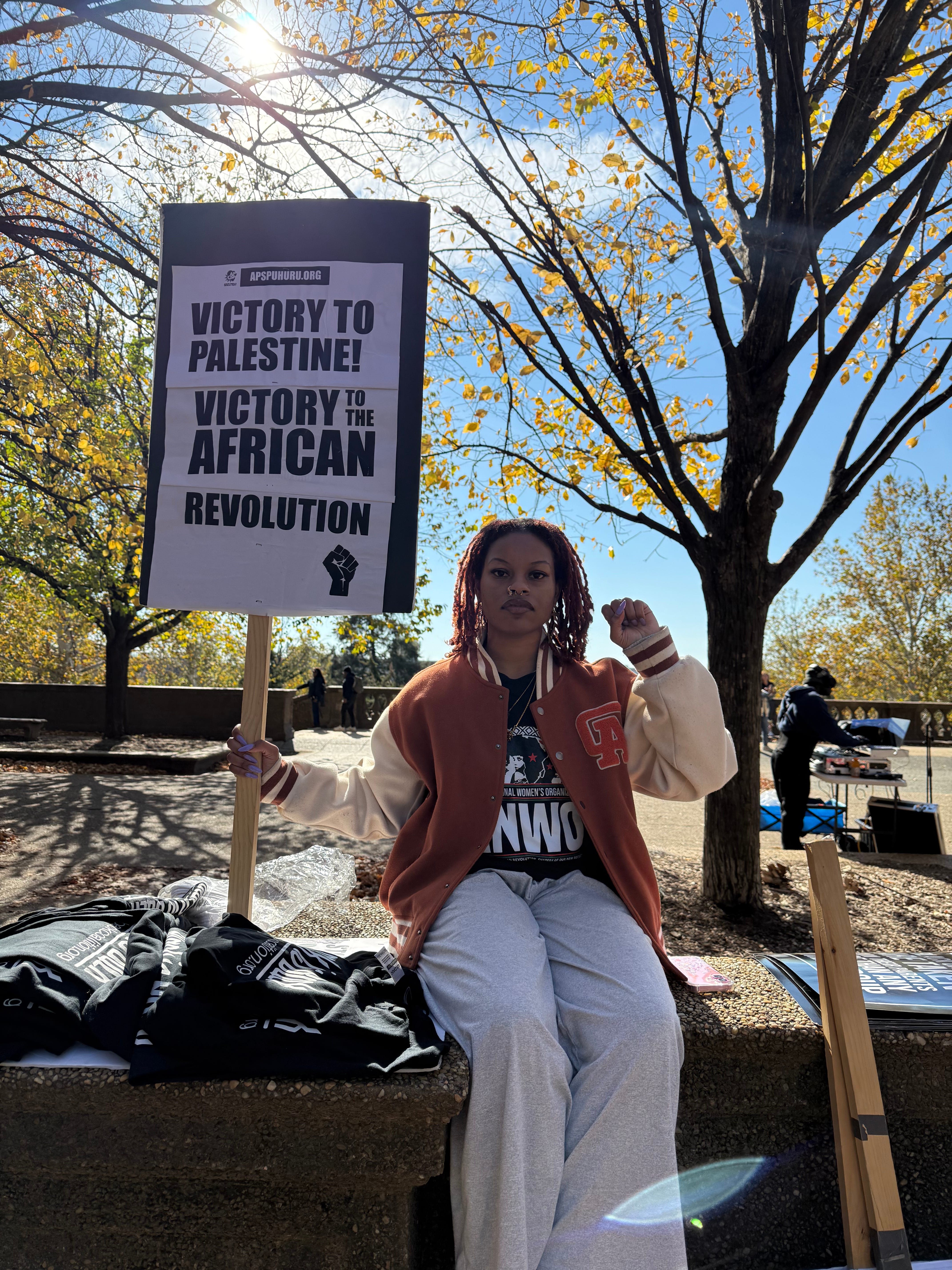
A Howard University graduate student who attended the march for the first time also experienced the power of collective organization and unity:
“The march was exhilarating, but the excitement and energy of it was not what made it so special; rather, the deep shared commitment to humanity and collective empathy—sadly, a radical notion at present—is what made the march so meaningful: comrades sharing in a dedication to protection and decolonization.”
Another HU graduate student, Ari Kamau, also attended the march for the first time after noticing the posters decorating the street lights up and down Georgia Avenue. When asked why he attended, he said, “I want to organize more with younger people, get their ideas on Pan-Africanism and organize together and see how to best bring revolutionary [power] to the community.”
Ari continued, “I think it’s really important to consolidate power, and these marches are the best way to do it. But also making it known that we are still here and that the fight still continues.”
Marching on the White House
The high energy sustained as comrades lined up and made their annual trek to the seat of white power, voices booming in unison, “Trump, Trump! You can’t hide, we charge you with genocide!” They carried signs boldly reading “Victory to the African Revolution!” “Reparations Now!” and “Hands Off Africa!”
A call for unity and reparations
On Sunday, November 2, the BIBC closed off the weekend with its virtual and in-person conference, featuring the Chairman of the APSP and the BIBC, Omali Yeshitela.
In his presentation, Chairman Omali reemphasized one of the main founding tenets of the BIBC.
He noted, “I want to just remind everybody that the last name of our coalition is reparations. And it’s important to say that because there have been some who have mischaracterized what we mean when we talk about reparations or the significance of the reparations movement. They have inferred, and sometimes explicitly stated, that to believe in reparations—or to believe we can get reparations—is a form of lunacy or an agent of the colonizer, and that reparations can only come as a consequence of defeating colonial capitalism. That’s how it has to be viewed; otherwise, again, it’s an expression of lunacy or being agents of the State.
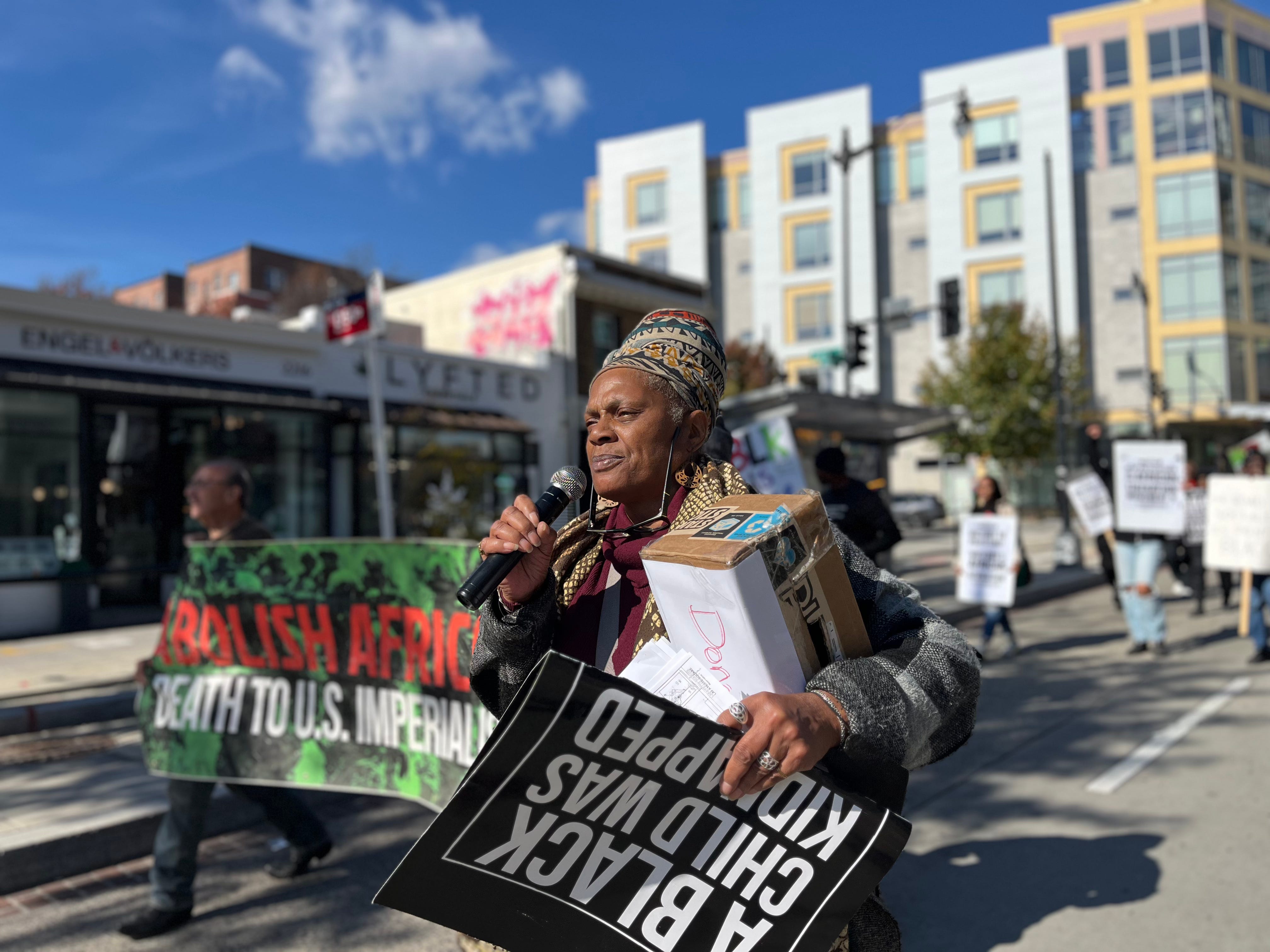
“We say it’s an infantile, immature position, partially because it makes the assumption that one has to either be for reparations or for the struggle to liberate our people from colonialism or colonial capitalism. And the fact is that it’s not that simple. We believe in dialectics—our approach is scientific to this question—and we understand that revolution is not a simple event, but it is a process.
“It speaks to a question of philosophy: what is your philosophy? What is it that you believe in? We have a movement of African Internationalists that includes most of the people who are part of our coalition. We are African Internationalists.
“So, what is your strategy? If you’re talking about making a revolution, there has to be some kind of strategy. And if you are a colonized people, you understand that the strategy has to be something that unites the majority—or certainly the critical component—of the colony against the oppression that we are experiencing. And there has been nothing that has united African people in this period of struggle more than the question of reparations.”
With his own life and Uhuru Movement organizing as a testament to the efficacy of the strategy of raising up the reparations question, Chairman Omali reminds us that this is a critical strategy to “bring African people together in the struggle against colonialism.”
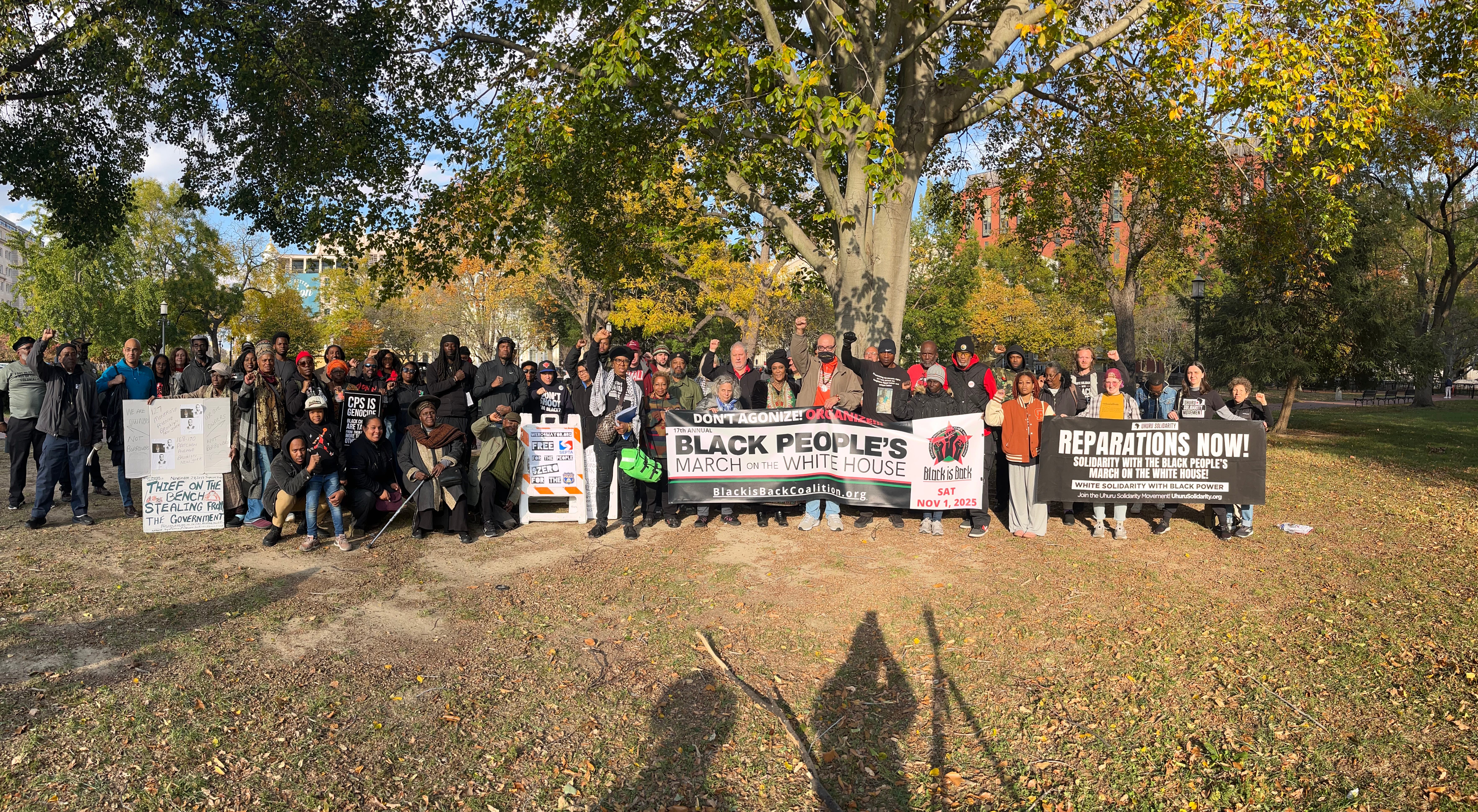
The struggle continues
Like the marches before it, the BIBC once again reemphasizes the pressing need to continue to organize and to keep the struggle alive wherever we may be located.
To watch the full pre-march rally and conference, visit The Burning Spear TV YouTube Channel.


