

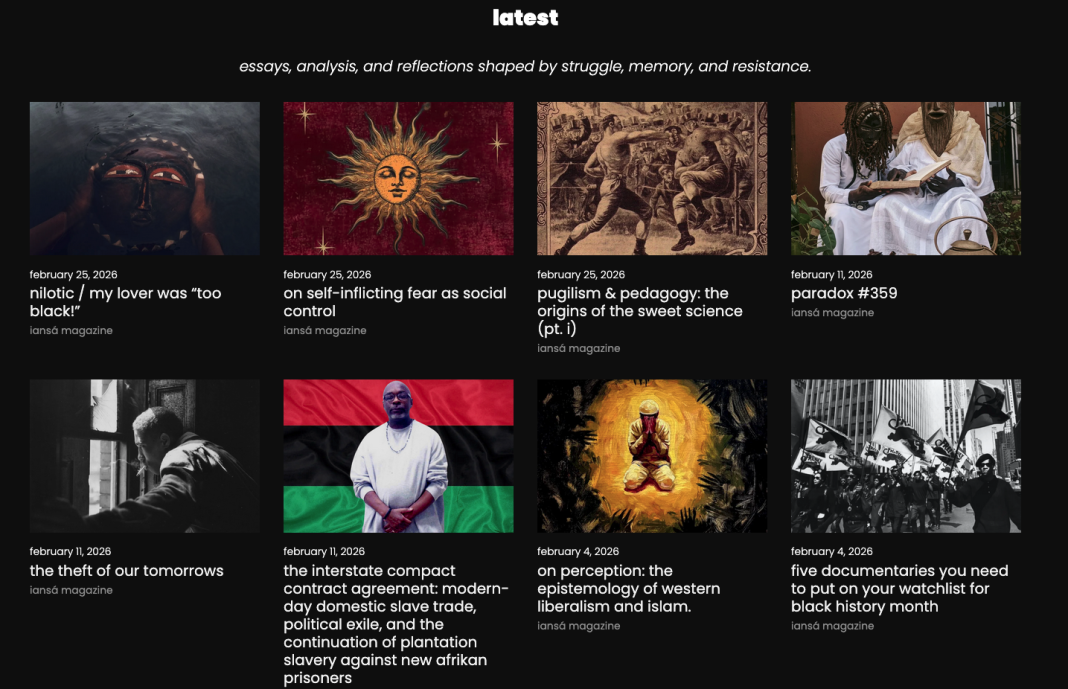
Iansá Magazine: a weapon in the war of ideas
The Burning Spear Managing Editor, Solyana Bekele sits down with Party member and Editor-in-Chief of Iansá Magazine Maryam Muhammad to discuss the origins, mission and political orientation of Iansá Magazine as a cultural weapon in the struggle for African liberation.
Solyana Bekele: What made you want to start a magazine like Iansá? What were the political, social and cultural trends you were noticing that made you want to organize Iansá as a multifaceted media outlet?
Maryam Muhammad: As a child, my parents often exposed me to media that was raw and unfiltered when it came to centering African perspectives and thoughts. We had Final Call Newspapers and old copies of Muhammad Speaks scattered throughout the house, and the local mosque I attended as a child once ran a black bookstore that had an array of CDs, DVDs and brochures. There was religious, political and cultural nationalist material sold there. So you could walk in and find books by Louis Farrakhan, Dick Gregory and H. Rap Brown all in one place.
When I first started Iansá in April of the previous year, I noticed a trend: many publications were inaccessible to African working class people, even those that claimed to be black-led and focused on social justice issues. It felt like a club where you needed to have some kind of “in.” They don’t answer email inquiries, and they don’t care about your pitches as a writer. I wanted to create a community-oriented platform that didn’t feel “bourgeois.”
SB: Were you inspired by any journalist, writer or editor from the cultural history of African people or the African liberation movement when putting together Iansá?
MM: In terms of inspiration, Glen Ford, Claudia Jones and Gil Noble have been instrumental in my decision to use writing and media as a platform to confront contradictions that harm African communities. Gil Noble has especially always made me think about how we have to document our own stories and make sure we control the narrative.
SB: Revolutionary journals have historically been weapons of political education—from The Black Panther to The Burning Spear. How does Iansá situate itself within this tradition?
MM: Iansá is a bit unique as a publication because it almost functions as a quiet weapon. We pull people in with our esoteric, “spiritual feel.” We’re named after an Orisha from the Candomblé tradition practiced by Africans in Brazil, so when people see the name and imagery, they might think we don’t engage in politics at first. However, when they read our articles, our writers are talking about the violence of capitalism, and if we’re covering religion and spiritual content, we’re speaking about it in terms of organizing against empire.
We are pretty on the outside, but still rooted in resistance!
SB: What would you say is the political orientation of Iansá as well as your target audience? Why is this important?
MM: Iansá is a collective of primarily African people (and those in solidarity) who connect through an anti-imperialist, anti-capitalist lens. Our target audience is anyone who knows that media plays a role in organizing the people when it comes to examining the system, and of course, wants to see a better world for all oppressed peoples. Whether it’s through music, film, photography or writing, it’s crucial for us to be able to disseminate information (and try to have fun while doing it).
SB: Why is it important for African people to engage with revolutionary journals like Iansá or The Burning Spear?
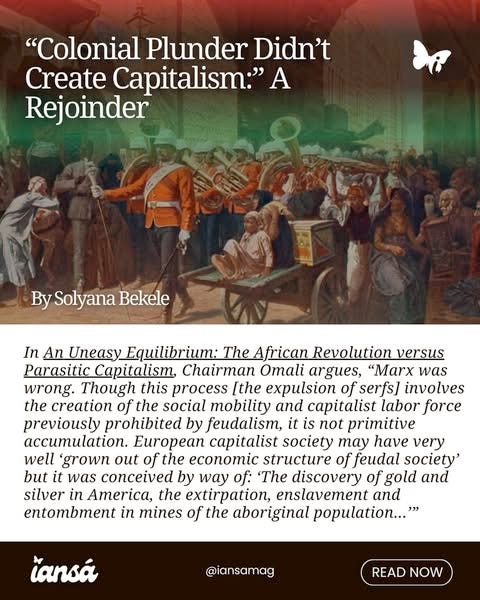
MM: Iansá and The Burning Spear are created by people who constantly envision liberation. They are efforts at trying to push back against State-controlled corporate media that have no interest in honest reporting.
SB: What would you say are some commonalities between The Spear and Iansá?
MM: Both The Burning Spear and Iansá are created and staffed primarily by African organizers. Both The Spear and Iansá also maintain an internationalist perspective of the black liberation struggle.
SB: In what ways do you see cultural work—art, poetry, design, photography—as part of the ideological struggle?
MM: I see cultural work as a part of the ideological struggle by way of introducing revolution to people who sometimes can’t receive it in its rawest form. Sometimes, as revolutionaries and organizers, our first instinct when approaching the masses is to try the classic approach: telling them the party line. However, some people don’t understand it at first until they hear it in a song by a group like Dead Prez or see it in a photo by someone like Gordon Parks or read it in a poem by someone like Amiri Baraka or Nikki Giovanni.
The arts have always played a role in helping the masses wake up and become conscious!
SB: How does Iansá counter the colonial, bourgeois and anti-African narratives imposed by mainstream media?
MM: Iansá counters such narratives by rejecting Western liberal frameworks, as our contributors do not recognize them as legitimate. This is why we go out of our way to center conversations and ideas put forth by people who are regularly suppressed or ignored by mainstream media. It’s also my opinion that under colonialism, there is no such thing as “fair” or “objective” news/reporting because the material conditions make that very concept impossible. Furthermore, colonized people should never seek to be “objective” about a world built on their oppression.
SB: How can readers and supporters actively participate in strengthening Iansá and the revolutionary media front as a whole?
MM: One of the best things people can do is use what they learn from platforms like these by taking their conversations offline and connecting with people in real life. If people watch the videos we put out and truly read the material on our website, they know that all roads lead to building toward revolution. People who truly value the messages we convey in our work know that the work is primarily offline.


