

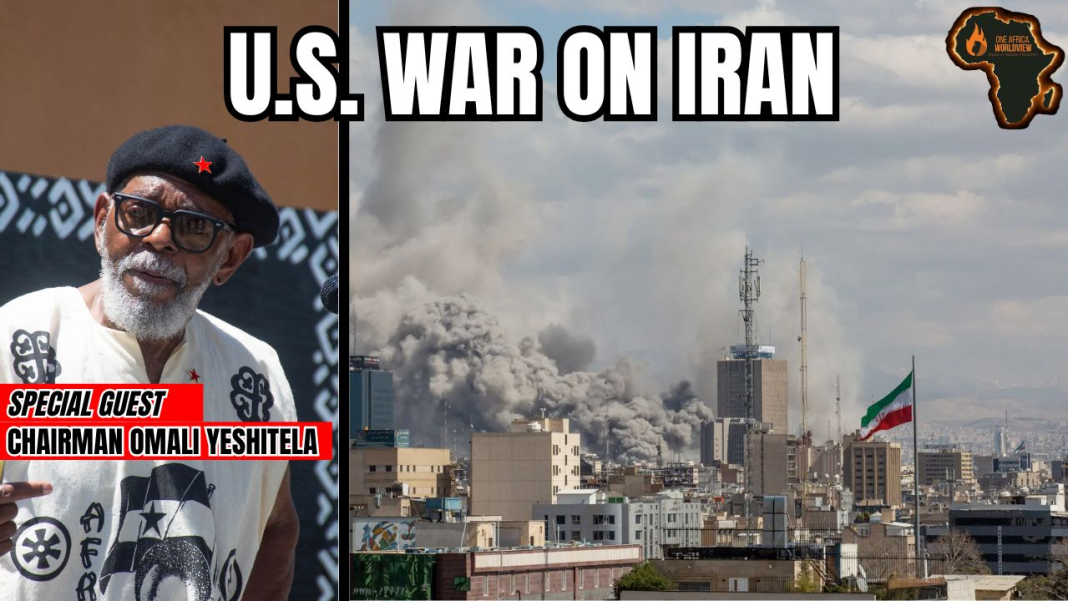
The following is a condensed transcription of Chairman Omali Yeshitela’s statement made on episode 34 of the One Africa Worldview Podcast that was broadcast on Monday, March 2, 2026.
Uhuru! First of all, I want to thank you very much. I really appreciate being able to have this discussion with you and with our listeners and to take an African internationalist interpretation of what is happening and the historical basis for it.
Because if we simply listen to what is being delivered to the people through legacy media—colonial media—we see this as just some kind of one-off operation.
We hear that the leader they just murdered, Khamenei, was this authoritarian force. Even people who claim to be for democracy—the British Parliament, the French, the Germans, and all of them—on the one hand say they may have not liked how the US regime just carried out this aggressive and murderous mission of assassination and continuous colonial rape. On the other hand, they are characterizing this as something that, despite how they may disagree with what this government has done and even questions regarding legality under international law, they still see as having some positive aspect.
I think it was Cory Booker, a Democratic Party negro here in the United States, who talked about how he was opposed to the fact that Congress did not give permission for this war that is being initiated, but on the other hand, felt there was something positive about overthrowing this government because [they view it] as an authoritarian tyrant responsible for spreading and contributing to terror throughout the Middle East, which is an extraordinary claim.
What is happening is something we in the African People’s Socialist Party and the Uhuru movement want everybody to understand: this is not some one-off situation. Maybe Donald John Trump went about this thing differently, but it was James Earl Carter who was president in 1979 when the people of Iran—mostly young people and students at the time—overturned and moved on that US embassy. They characterized it as a “nest of spies,” which was true. The US embassy functioned as the institution through which Iran was being controlled through the Shah of Iran, whom they had put in power.
This is not a one-off situation. Iran, along with the illegitimate white nationalist settler state of Israel, functioned as the police organizations controlling the Middle East and Africa. That was a primary role they had.
We worked with the Iranians going all the way back to the 1970s. We supported the Iranian opposition to the Shah of Iran, who again was put in power by the United States government.
It is worth mentioning this while listening to Booker and others talk about the “authoritarian” government of Iran: under the Shah, Iran had a secret police organization called the SAVAK. Iranian students in this country, to demonstrate against the Shah even inside the United States, wore paper sacks over their heads with holes cut for their eyes. They wore these sacks because the SAVAK—the Iranian terroristic secret political police—worked with the US secret political police to identify people, track their families down in Iran, and do horrible things to them.
We had this relationship with the Iranians. When the Iranians took the embassy, they captured information contributing to a deeper understanding of the role of the US government in using Iran as a base for aggression against not only the Iranian people, but people throughout the Middle East and Africa. The Carter administration presided over this process, and in fact, this was something that helped Carter lose the election to Ronald Wilson Reagan. Reagan, prior to the current US president, was also about “making America great again” (and white again).
When they couldn’t hold on to Iran, it was perceived as a huge defeat by the Democratic party Carter regime. It’s not that Carter didn’t try; they sent helicopters in with a team of US forces to try and rescue the so-called hostages. But sand got into the engines, the helicopters crashed, and it was a complete disaster.
This is also where we saw the emergence of the Iran-Contra affair. The Reagan administration, prior to coming into power through back-channel doors, made an agreement that the hostages would not be released before the pending election.
Reagan wanted this to be a badge of shame to hang around Carter’s neck to push forward his own election. They engaged military forces—some existing CIA agents and some retired—to engage in the drug trade.
They put drugs in our community to raise money to buy guns to forward counter-revolutionary struggles in Nicaragua and El Salvador. This was the emergence of the Contras and the rise of people like Colonel Oliver North, who had tons of money as a consequence of reaching this agreement with Iran at the time.
There has always been an ongoing mixture of hostility directed at Iran because Iran broke out of the situation where the Shah, along with Israel, worked to control the Middle East and Africa in the interests of the US and other traditional colonial powers. From the very beginning, our Party was able to unite with the struggle of the Iranian people. First, because we find the whole idea of colonial control of people repugnant, and second, because we understood the relationship the colonization of Iran had with African people.
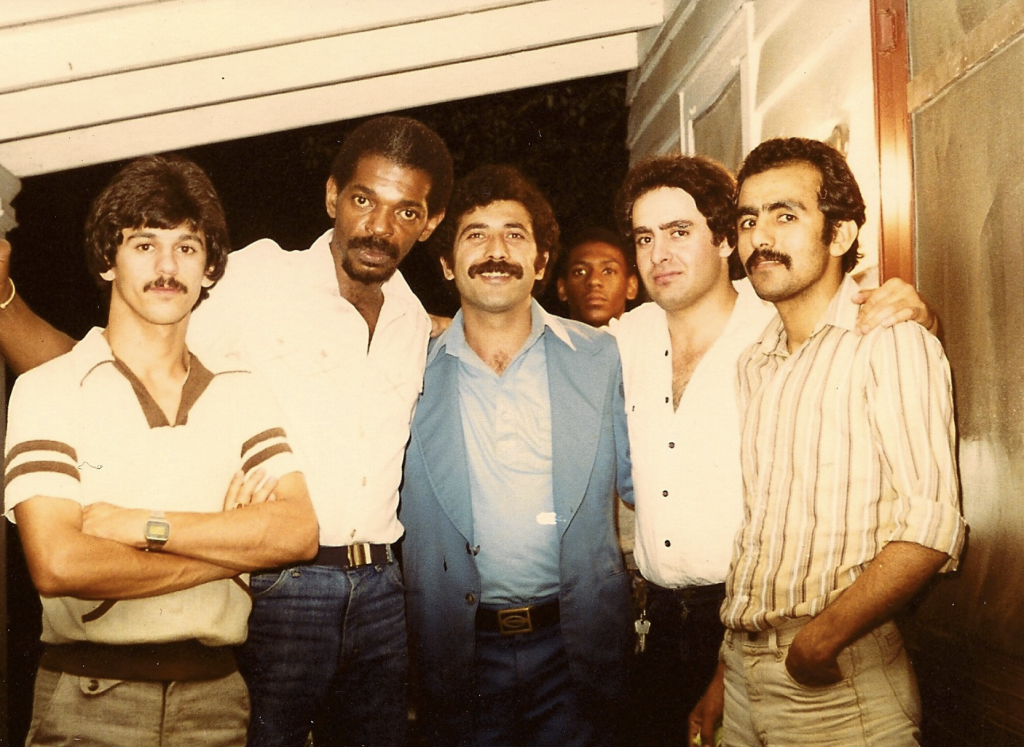
African and Iranian solidarity
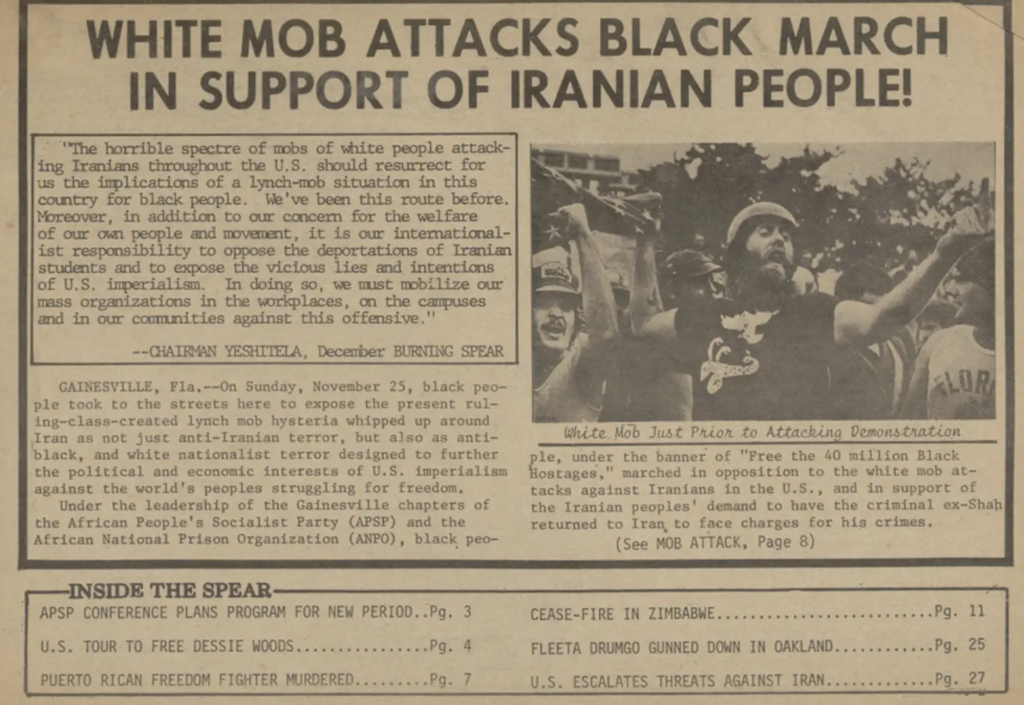
At the time, we had a significant base in Gainesville, Florida, where the University of Florida is located. On that campus, you had nighttime rallies by white students with slogans like “Sand-niggers go home” and “Send the Klan to Iran.” Throughout the United States, white people were attacking people who they presumed to be Iranian if they wore turbans, whether they were Persian or Arab. It didn’t matter; it was a frothing at the mouth kind of lynch-mob mentality that had been raised inside this country to attack anybody forwarding the interests of colonized people against US domination. And in this instance, it was Iran.
It was really important because, Iran was this force that was a shame and embarrassment. Because this whole notion of “The old flag never touched the ground,” and “America never lost a war” and “white power over everything.” This was a prevailing notion, and part of the ideological essence of any regime in this country is the presumption of the invincibility of white people and this was what we were seeing with the attack on Iran and the response of the Iranian people.
We organized a demonstration in Gainesville in 1979 in support of the Iranian people both in Iran and in the U.S. On the first demonstration, where hundreds of Africans—mostly young people—marched with us, we were attacked by hundreds of white flag-waving idiots chanting “America, America, America.” They ripped up the red, black, and green flag leading the march.
The Gainesville Sun—the legacy newspaper there—editorialized against the mobilization. They got black preachers in Gainesville to preach from the pulpits to keep African people from joining the march in solidarity with the Iranian people. But we marched anyway, right into the middle of this mob. As they were chanting “America,” we started chanting “Africa.” I stood up on a makeshift platform and said, “The sand-niggers are here.”
The police, who were supposed to be providing security, told us we couldn’t go any further once we reached a certain government location. I told them to go where they wanted, and we kept moving the march until we crossed into the African community. When we crossed into the African community, Africans started coming out of the clubs and houses. They faced these “America” chanting white people carrying red, white, and blue flags and told them, “You’re not in America now.” These are people who had nothing to do with our mobilization, but they understood exactly what was happening and they chased those white people out of there.
The white people left running, but it was a very perilous situation. This contradiction has always had to do with more than just Iran.
The crisis of this social system has gotten deeper and deeper. Iran represented a part of the crisis when the people rose up, as did Nicaragua when the people rose up, took their country back, and began to develop for themselves and therefore, in the process of so doing, taking their resources back from the colonizers.
At that time, Iran had perhaps the third-largest oil supply in the world after Venezuela and perhaps Russia. They wanted that oil to be no longer available to the people of Iran. Just like, they don’t want oil available to the people of Venezuela, so they sanction them and do everything they can to crush their capacity to feed, clothe, and house themselves. This is how colonialism works–how it has to work.


