


St. Louis is in crisis mode following the May 16, 2025 EF-3 tornado that tore through north St. Louis, killing seven people and damaging thousands of homes and businesses.
“I think what all these people are a little upset about is that that red tape puts an impact on all these folks that are here,” said Ray Porter, who owns rental property in north St. Louis that was damaged in the storm, according to St. Louis NPR on January 20.
“We are in crisis mode. This is like trying to revive somebody two or three days after they’ve had a heart attack,” Porter said at a town hall meeting held January 20 at Yeatman Liddell Middle School in the heart of the impacted community.
An estimated 5,000 homes and rental units and more than 800 businesses were impacted by the tornado. The City of St. Louis has mismanaged the relief effort, leaving devastated communities struggling to recover months later.
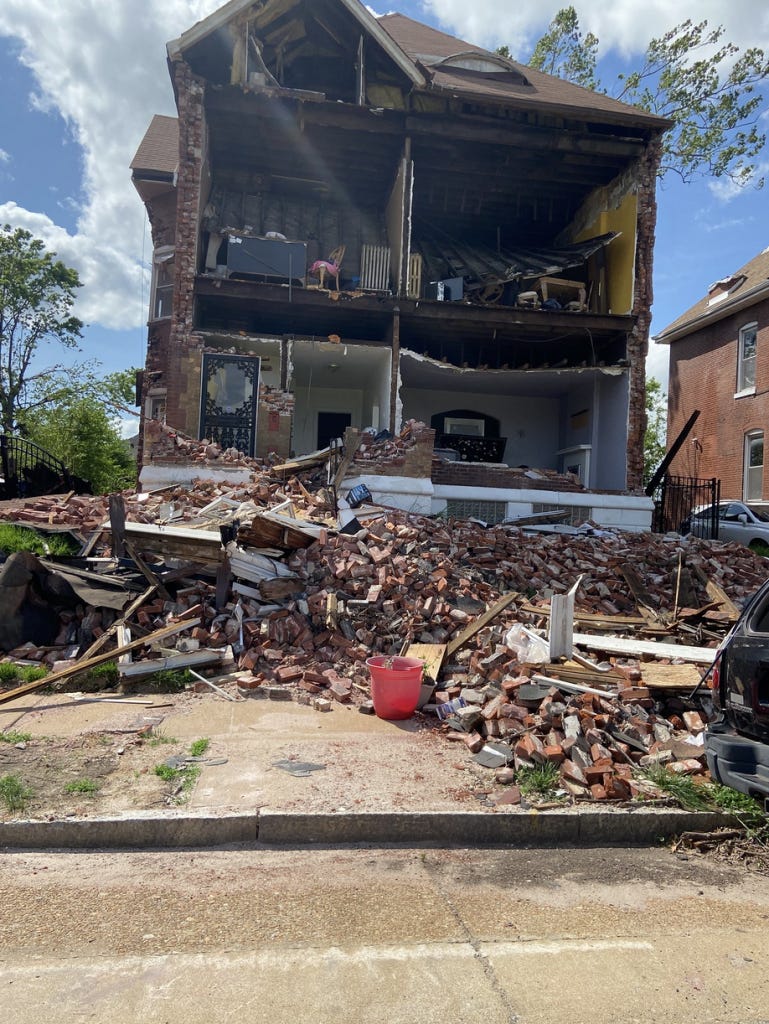
Relief shut down as need grows
Chief Recovery Officer Julian Nicks informed residents that applications for the Private Property Assistance Program will close February 14.The city says it is overwhelmed with applicants. Residents say the city is ill-prepared or unwilling to meet the needs of the African community.
Missouri state lawmakers made $100 million available in 2025 shortly after the tornado to assist with rebuilding. The city has not allocated any of those funds to help the African communities hit hardest by the storm.
While residents wait for meaningful relief, the St. Louis Development Corporation has identified six African communities adjacent to the National Geospatial-Intelligence Agency (NGA) for potential eminent domain projects.
The NGA facility, valued at $1.75 billion, sits less than two miles from Uhuru House. In December 2025, the International People’s Democratic Uhuru Movement (InPDUM) convened a community discussion to address these developments.
City officials claim there is no money to assist homeowners and business owners on the north and west sides. Yet resources appear readily available for projects that threaten the existence of African communities.
Developers circle African neighborhoods
A central figure in these redevelopment plans is Paul McKee, founder of NorthSide Regeneration. According to the January 25 edition of NextSTL, McKee controls approximately 1,600 real estate parcels covering more than 200 acres.
Recent business and media reports highlighted the JeffVanderLou community as an area targeted for redevelopment. JeffVanderLou has a population of 4,209 people. Approximately 92.3 percent are African and 2.9 percent are white.
NextSTL published photographs of streets and rundown buildings, many owned by McKee, to justify redevelopment. The question remains: redevelopment for whom?
Chairman Omali Yeshitela has described this process as the colonial mode of production. He defines it as a system of foreign domination that extracts wealth from the colonized for the benefit of the ruling class.
Residents see the parallels. The EF-3 tornado tore through north St. Louis. Now political and economic forces are tearing through the same communities under the banner of “development.”
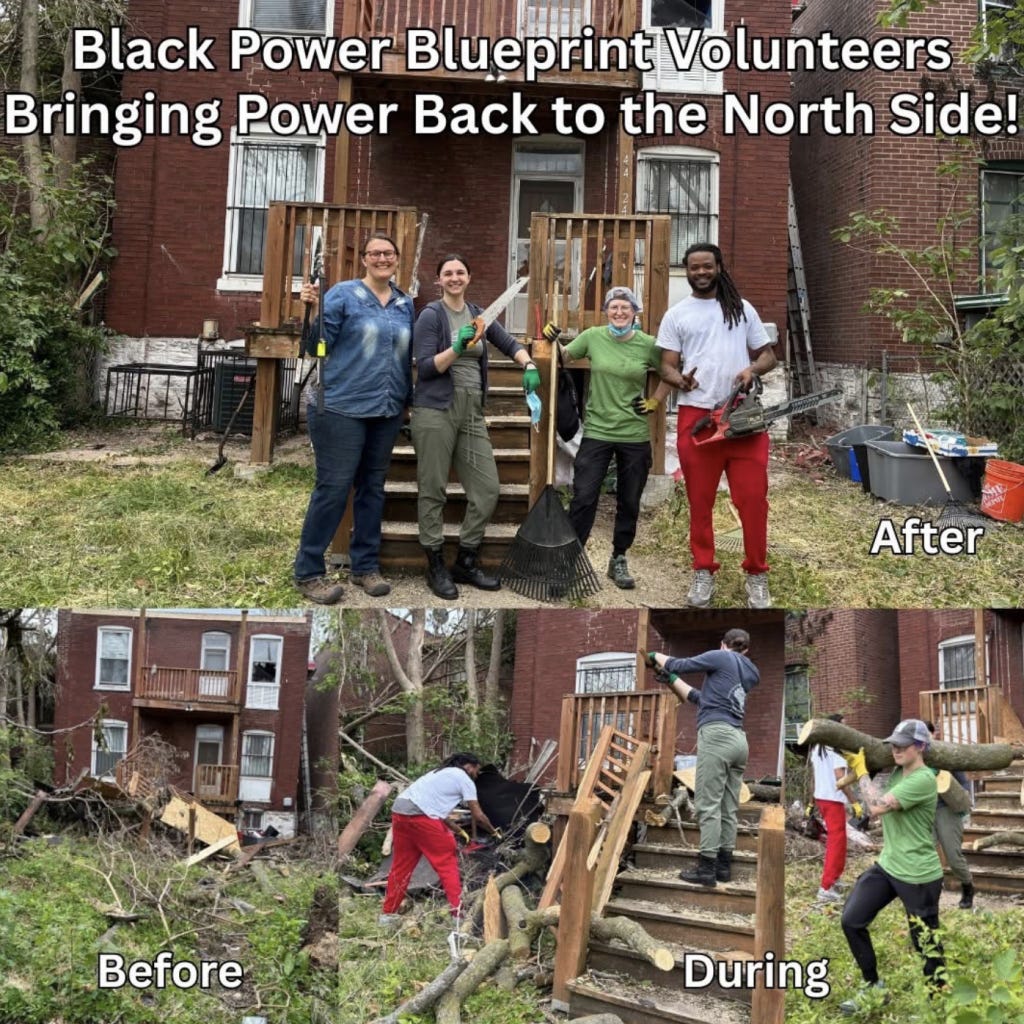
Fight back through self-determination
Ward 14, represented by Alderman Rasheen Aldridge, sits at the center of this struggle. Mayor Cara Spencer has also played a leading role in shaping the city’s response. What is the fight-back plan for the African community in St. Louis? Chairman Omali Yeshitela, a veteran of the African Liberation Movement, teaches that it is not enough to explain the world. We must change it.
The Reparations Investment Corporation (RIC) has emerged in north St. Louis with the goal of creating “renovation that contends with gentrification.” RIC is the latest expansion of the Black Power Blueprint led by the African People’s Education and Defense Fund (APEDF) under board president Ona Zené Yeshitela. Its aim is to build independent political and economic power in the hands of the African community.
RIC is coordinated by the Uhuru Solidarity Movement (USM), which follows the leadership of the African People’s Socialist Party (APSP).RIC currently manages the rehabilitation of two properties and recently installed a new roof on one.
These properties will be sold to members of the African community. The resources generated will be recycled to fund additional projects.
Chairman Omali Yeshitela confirmed that to support RIC is to make “the greater investment” in a future where African people have self-government and power over their lives.
He stated that the city “is now exploiting the devastation caused by the May 16 tornado as an opportunity to accelerate this destructive plan [Team 4 Plan] at the expense of the African community.”
He noted that this process has been underway for decades and intensified with the construction of the NGA facility.
The people see it. The sell-outs see it. The colonial master sees it.
This time, the struggle continues until victory is won.
Fist Up, Fight Back!
One Africa! One Nation!


